

Introduction
Farming has been the backbone of human civilisation for thousands of years. However, the current farming practices are much different from the manner in which crops were grown several generations ago. Agriculture has gradually changed with time, starting with the ploughs and hand tools pulled by bullocks to irrigation systems, better seeds, and so on.
This has resulted in two different methods of farming: traditional farming and modern farming. Understanding the difference between traditional farming and modern farming helps us see how agriculture has adapted to changing needs, technologies, and environmental challenges. This guide will compare the traditional farming method to the modern farming system, their advantages and disadvantages, and how such mechanisms impact farmers.

What is Traditional Farming?
Traditional farming refers to agricultural practices that rely on natural resources, manual labour, and age-old knowledge passed down through generations.
This type of traditional agriculture existed long before advanced machinery or modern technology. Farmers depended on local climate patterns, soil fertility, rainfall, and animal power to grow crops.
Most traditional farming methods involve simple tools such as ploughs, sickles, and hand-operated equipment. Synthetic inputs were used less extensively, and soil fertility was often supported through natural inputs, and soil fertility was maintained through natural inputs like compost and crop residues.
In many rural regions, traditional farming is still practised today because it requires lower investment and works well on small farms.
Traditional Farming Methods
Manual and animal-powered farming
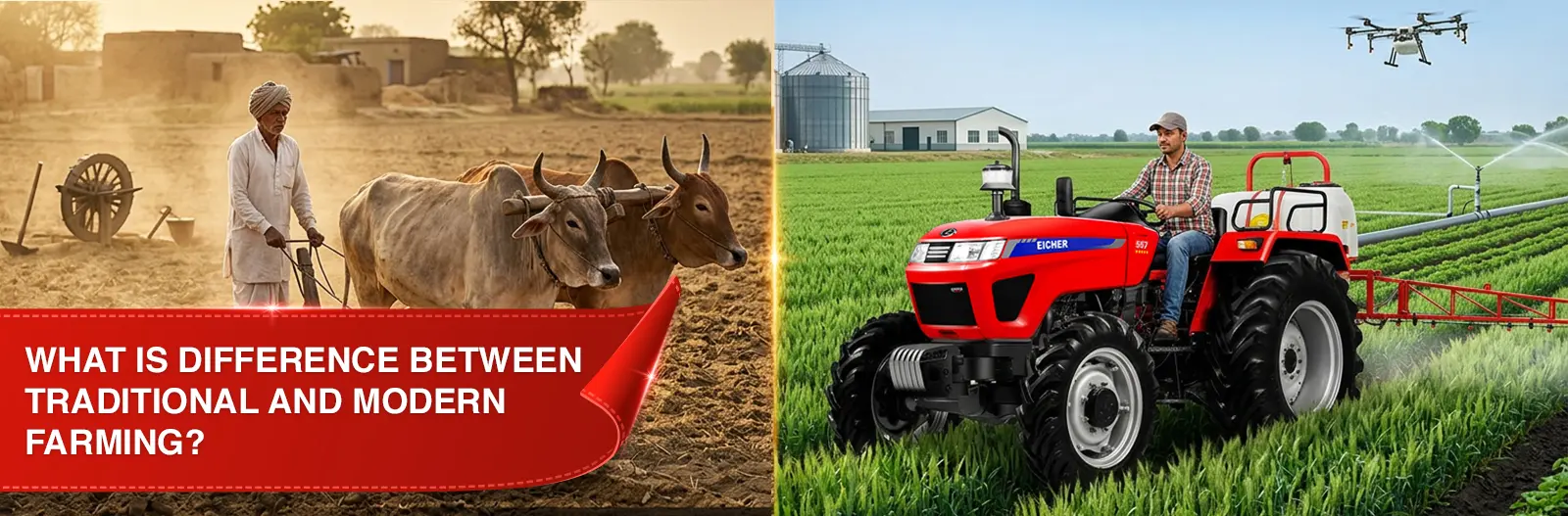
One of the key features of traditional agriculture is the use of human labour and animals for farm work. Farmers often rely on oxen, bullocks, or horses to pull ploughs and prepare the land.
Basic tools like wooden ploughs, hoes, and sickles are used for sowing, weeding, and harvesting crops.
Natural soil fertility management
Instead of chemical fertilisers, traditional farming methods encourage farmers to maintain soil health using natural materials. These include farmyard manure, compost, green manure, and crop residues.
Other practices include crop rotation and mixed cropping, which are used to ensure the nutrients in the soil are maintained, and there is no problem of pests.
Benefits of Traditional Farming
Environmentally friendly practices
Traditional farming often relies more on natural and locally available inputs, which contributes to safeguarding the health of soil, water, and biodiversity. With time, the soil is enriched with natural fertilisers and organic matter.
Lower input costs
Costs of production are also low since farmers use locally available raw materials like manure, crop residues, and animal labour.
Supports biodiversity
Conventional agricultural production systems tend to produce more than one crop. Such a variety contributes to the preservation of the ecological balance and decreases the probability of the complete loss of crops.
Suitable for small farms
In the case of the small landholding farmers, the traditional farming methods may be viable, as they do not involve heavy machinery investment.
Considerations in Traditional Farming
Lower productivity
The yields of crops are usually lower than those of modern farming methods. Access to highly developed equipment, irrigation and better seeds is limited, limiting production capacity.
Seasonal dependence
Traditional agriculture is quite dependent on rain and the natural weather conditions. This can make outcomes more dependent on rainfall and seasonal conditions.
Labour-intensive
The physical effort and time taken in manual work are high, particularly in the seasons of sowing, weeding and harvesting.
What is Modern Farming?
Modern farming is the application of modern technology, machines and scientific methods in farming to enhance efficiency and productivity.
In contrast with traditional farming methods, modern farming is aimed at the maximisation of crop production without excessive use of manual labour. The use of equipment, like tractors, harvesters, irrigation systems, and enhanced seeds, is important.
Companies like Eicher Tractors have helped farmers adopt mechanisation by providing reliable tractors and implements that simplify field operations.
Modern Farming Methods
Mechanised farming
Most of the manual labour in farming has been taken up by machinery. Farmers use tractors, seed drills, harvesters, and other tools, which assist them in accomplishing their work more quickly and accurately.
High-tech irrigation systems
The irrigation technologies that are commonly used in modern farming include sprinklers and drips. Such practices help in making sure that crops get the appropriate amount of water and also in minimising waste.
Improved agricultural inputs
The other important feature of modern farming methods is the use of better seeds, fertilisers and crop protection solutions. Improved and hybrid seeds are capable of yielding more products, whereas fertilisers provide the necessary nutrients that are required to support plant growth.
Benefits of Modern Farming
Higher productivity
Among the greatest benefits of advanced farming is a higher crop output per hectare. Farmers are able to produce more food using the same amount of land due to improved seeds, fertilisers, and mechanisation.
Faster farm operations
Machines allow farmers to complete work quickly, especially during peak agricultural seasons. Tasks like ploughing, sowing, and harvesting take far less time.
Labour efficiency
With mechanisation, farmers depend less on manual labour. Equipment such as tractors and harvesters makes farming operations smoother and more efficient.
Considerations in Modern Farming
Environmental concerns
Input use in modern farming works best when managed carefully to support soil health, water quality, and long-term sustainability.
Higher investment costs
Modern agriculture often requires significant financial investment for machinery, fertilisers, irrigation systems, and advanced seeds. For some farmers, these investments may require careful planning or access to financial support.
Traditional Farming vs Modern Farming
The difference between traditional farming and modern farming becomes clearer when we compare their key features.
Difference Between Traditional Farming and Modern Farming
| Aspect | Traditional Farming | Modern Farming |
| Approach | Depends on natural methods. | Uses technology and scientific methods. |
| Tools | Simple hand tools and animal power. | Tractors and advanced machinery. |
| Labour | More manual labour. | Less manual work. |
| Crop Yield | Typically Lower crop production. | Higher crop yields. |
| Fertilisers | Uses compost and manure. | Uses chemical fertilisers and improved seeds. |
| Cost | Low investment. | Higher investment. |
| Environmental Impact | More eco-friendly. | Requires careful input management to manage soil health. |
The difference between traditional farming and modern farming lies in the level of technology, input usage, and overall efficiency. While traditional methods rely more on manual labour and natural inputs, modern farming focuses on improving productivity through mechanisation, irrigation, and improved seeds.
Can Traditional and Modern Farming Work Together?
In many cases, farmers combine traditional knowledge with modern techniques to achieve better results. Using improved tools while maintaining soil health and local practices can create a more balanced and sustainable farming approach.
Conclusion
Agriculture today is shaped by both traditional wisdom and modern techniques. While traditional practices support ecological balance, modern methods help meet growing food demands.
The future lies in combining both, using technology responsibly while maintaining sustainable practices. Understanding these differences helps farmers choose what works best for their land and needs.
If you’re planning to adopt mechanisation, explore the right tractor for your farm at Eicher Tractors: Eicher Tractors