

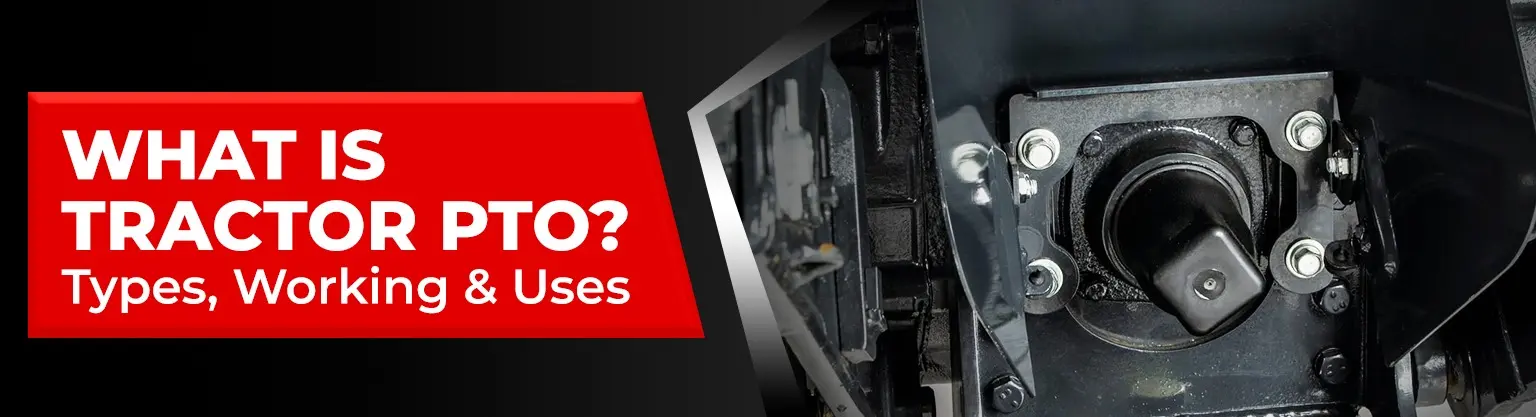
Introduction to Tractor PTO
In modern agriculture, tractors aren’t used only for pulling implements; they’re also for powering them. And that’s exactly where Tractor PTO becomes a big deal. PTO helps one tractor handle multiple jobs: land preparation, sowing, spraying, pumping water, shredding, and even running post-harvest machines.
In case you ever wondered what a tractor PTO is and why farmers are so serious about it, think of it as the tractor’s “power outlet”. It minimises the need for manual labour and independent engines, saves time during peak season, and streamlines farm operations.

What is Tractor PTO?
Let us begin by defining the tractor PTO’s meaning. PTO is an abbreviation that means Power Take-Off, a device that passes the power from the engine of the tractor (via the gearbox/transmission) to an implement attached to it by a rotating shaft. It is that rotation that makes the implements work without the necessity of having their own engine.
This is why PTO in a tractor matters beyond transportation. A single tractor can run different equipment across crops and seasons, wheat, paddy, sugarcane, cotton, or pulses, depending on what your farm needs.
PTO in Tractor – How It Works
Here’s how PTO in a tractor works in real life. The tractor’s engine generates power, the transmission routes it, and the PTO shaft delivers that power to the implement at a fixed speed. Once the implement receives rotation, it starts doing its job – cutting, mixing, pumping, spraying, or shredding.
Basic working process includes:
- Engine power generation
- Power transfer through transmission
- PTO shaft rotation at fixed RPM
- Operation of the attached implement
If PTO is mismatched or overloaded, you’ll feel jerks, poor output, overheating, or even breakdowns.
Types of Tractor PTO
Transmission PTO
Transmission PTO works through the tractor’s transmission. When you press the clutch, PTO power usually stops too. It’s basic and works fine for many operations, but it gives less control over implementations during tasks where you need the tractor to pause while keeping the attachment running.
Live PTO
Live PTO keeps PTO running even if you stop tractor movement. It typically uses a two-stage clutch – one stage stops tractor movement, and the other stage controls PTO. For fieldwork where you stop and move repeatedly (like baling, reaping, or rotavator turns), Live PTO is a relief.
Independent PTO (IPTO)
IPTO operates independently of the tractor clutch using a separate lever or switch. You can start or stop PTO without affecting tractor movement. It’s excellent when you want precision and convenience, especially during spraying and harvesting operations or when multiple short PTO bursts are needed.
Economy PTO (Eco PTO)
Eco PTO gives the standard PTO output (usually 540 rpm) at lower engine RPM. That means less fuel consumption, less noise, and smoother light-duty operation. It’s ideal for operations like light spray pumps, small threshers, or low-load applications.
Eco PTO is not meant for high-load work where full-rated power is required.
Continuous PTO
Continuous PTO systems are built to deliver uninterrupted power for long-duration operations. This matters when you’re running equipment continuously, like irrigation pumps or post-harvest machinery, where stability matters more than frequent clutching.
Reverse PTO (RPTO/R PTO)
Reverse PTO allows the PTO shaft to rotate in reverse. Sounds niche, but it’s genuinely useful. When an implement gets jammed or stuck (like a post-hole digger or some rotary equipment), reverse rotation helps clear blockages and safely disengage.
Multi-Speed PTO (MS PTO)
MS PTO supports more than one PTO speed. Most commonly, tractors offer 540 rpm and 1000 rpm, or a dual-speed arrangement. This flexibility helps match different implements without compromising output.
Ground Speed PTO (GS PTO)
GS PTO (Ground Speed PTO) links PTO speed to tractor wheel speed. As the tractor moves faster or slower, the PTO speed changes accordingly. It’s useful in certain operations where the implemented action must sync with forward movement.
Importance of PTO in Tractors for Farmers
PTO isn’t just a feature; it’s a productivity tool. The reason tractor PTO is so valuable is that it turns one tractor into a multi-purpose power unit.
- It helps finish jobs faster during tight sowing and harvesting windows.
- It reduces labour dependence, especially when labour is costly or unavailable.
- It improves output consistency, particularly in rotavation, shredding, and pumping.
- It saves money by avoiding the need for separate engines for implements.
And honestly, PTO also helps farmers do more custom work – rotavator services, threshing, haulage support, and creating additional income during off-peak months.
Safety Measures While Using Tractor PTO
PTO is powerful. That’s why following safety measures is a basic discipline.
- Always use PTO shaft guards.
- Don’t wear loose clothing near a running PTO.
- Switch off the engine before connecting or disconnecting the PTO shaft.
- Make sure the PTO shaft length is correct and the coupling locks properly.
- Follow the implement manufacturer’s PTO RPM requirement.
- And never allow anyone to stand too close to a rotating shaft.
- Do a quick walk-around check before starting PTO: guards, pins, alignment, and oil leaks.
Applications of PTO
The following examples of PTO applications are indicative and not limited to the ones listed below.
| Application | PTO Speed | Advantage |
| Rotavator | 250-300 RPM | Helps in efficient soil preparation and fine seedbed formation. |
| Sprayer | 540 RPM | Ensures consistent spraying for better pest and disease control. |
| Irrigation Pump | 540 or 1,000 RPM | Provides reliable water pumping for irrigation without a separate engine. |
| Thresher | 540–1000 RPM | Separates grains from crops quickly during post-harvest operations. |
| Baler | 540 or 1,000 RPM | Compresses crop residues into bales for easier storage and transport. |
Conclusion
Tractor PTO plays a crucial role in modern agriculture by transferring engine power to multiple farm implements. It allows farmers to run equipment like rotavators, pumps, and threshers efficiently using a single tractor. Understanding what a tractor PTO is, how it works, and its applications helps farmers use their tractors more productively and manage farm operations with greater ease.