

Introduction
Farming today goes beyond sheer effort. It’s about smart choices that maximise productivity while conserving resources. The rotavator stands as a perfect example of this modern approach to agriculture.
From preparing seedbeds to mixing crop residue, rotavator use has transformed field preparation across India and beyond. This article explains what a rotavator is, the working principles of a rotavator, how a rotavator works, its key applications, benefits, and limitations, and how to choose the right one based on soil conditions. Let’s get started!

What is a Rotavator?
A rotary tiller or rotavator is a tractor implement that is used to prepare the soil. It is an implement that is applied to slice, stir, and smooth soil prior to sowing.
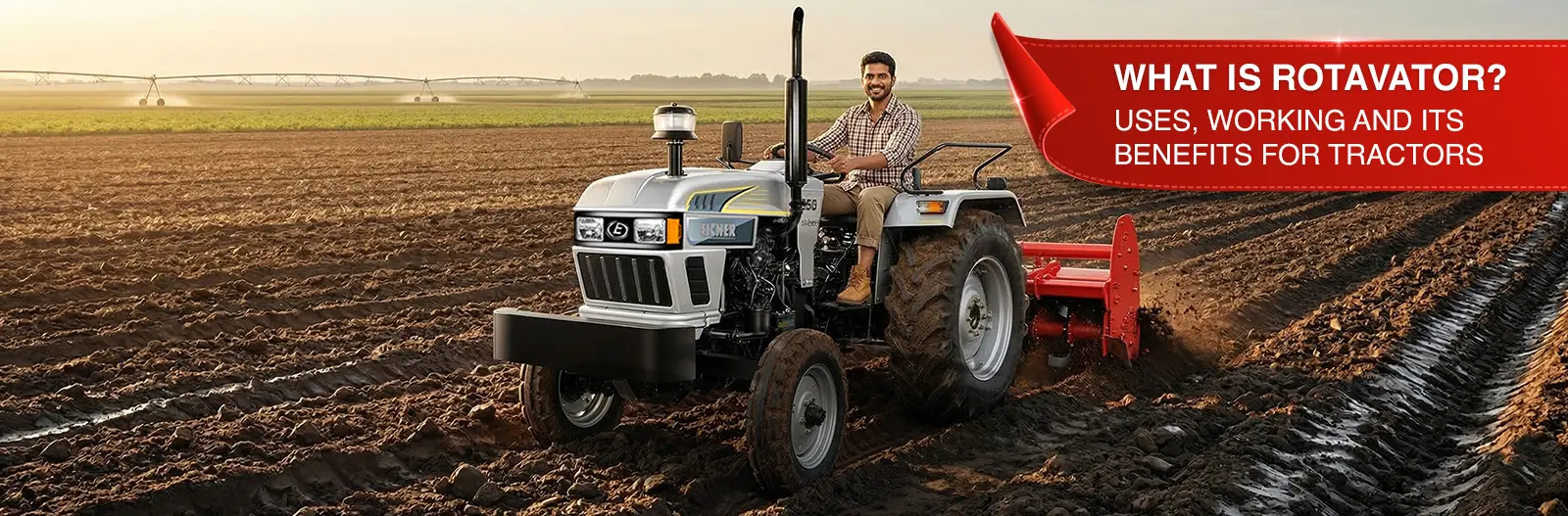
A rotavator is mounted to the tractor’s three-point linkage and driven via the PTO (Power Take-Off). With the rotation of the PTO, the soil is cut and mixed by a horizontal shaft with blades attached to it. It is also popular since it creates a fine seedbed with a minimal number of passages as opposed to conventional tillage equipment.
How Does a Rotavator Work?
The rotavator is attached to the PTO shaft of the tractor. The PTO passes the power to the rotavator gearbox when it is engaged, rotating the blade shaft.
When the tractor moves forward, the blades rotate in the same direction as travel (forward/down-cut rotation), cutting into the soil. This combination of forward tractor movement and blade rotation breaks up clods, blends soil, and forms a homogeneous surface.
Here are the key components of a rotavator:
- PTO shaft
- Gearbox
- Rotor shaft
- Blades (L-type, C-type, or J-type)
- Side plates for soil control
Uses and Benefits of a Tractor Rotavator
Efficient Tillage and Faster Field Preparation
An agricultural rotavator can handle both primary and secondary tillage in many soil conditions. Whether you’re loosening soil after ploughing or getting the field ready for sowing, it reduces the need for multiple passes.
Studies by ICAR show rotavators save 30–35% time and 20–25% operational cost compared to conventional tillage. That means less fuel consumption, fewer labour hours, and faster turnaround between crops. Simply put, you get more done in less time.
Fine Seedbed Preparation for Better Germination
Creating the right seedbed is half the job done in farming. A rotavator breaks soil clods and levels the field, giving you a smooth, uniform surface.
This improves seed-to-soil contact, which leads to better germination and a more even crop stand. And when crops grow uniformly, managing them becomes much easier.
Improved Soil Aeration and Structure
Healthy soil isn’t just about nutrients, it also needs proper airflow.
By loosening compact soil, the rotavator improves aeration and allows roots to grow deeper and stronger. Better root development means healthier plants and stronger yields over time.
Effective Weed Control
Weeds can quietly eat into your crop yield if not managed early.
Rotavators help by mechanically uprooting weeds during soil preparation. This reduces early weed growth and minimises the need for chemical herbicides, especially in the initial stages.
Mixing Residue and Enhancing Soil Fertility
One of the most practical uses of a rotavator in agriculture is residue management.
It chops and mixes crop residues and manure into the soil, improving organic matter content. This not only enriches the soil but also supports better moisture retention and long-term fertility.
Better Moisture Retention and Land Levelling
The fine soil structure created by a rotavator helps retain moisture, something that’s especially valuable in areas with limited irrigation.
At the same time, its side plates ensure uniform depth and proper land levelling. The result is a well-prepared field that supports consistent crop growth.
Higher Productivity and Farm Efficiency
When soil preparation is done right, everything else falls into place.
With fewer passes, better soil conditions, and improved crop establishment, rotavators help increase overall farm productivity. It’s not just about saving effort—it’s about getting better results from every acre.
Types of Rotavators
Not all rotavators are the same. They differ based on blade design, tractor power compatibility, and drive system.
Blade-based types
- L-type blades – Ideal for light and sandy soils. They cut and lift soil efficiently.
- C-type blades – Designed for hard, compacted, or clay soils. They dig deeper and break tough clods more effectively than L-type blades.
- J-type blades – Suited for heavy, clayey, or wet soils. Their narrower profile resists clogging and improves soil ejection, making them effective for residue mixing in tough conditions.
Choosing the correct blade ensures a better soil finish and reduces wear.
HP-based types
Rotavators are matched to tractor horsepower and differ for small tractors, mid-range tractors, and heavy-duty tractors. Matching implement size with tractor capacity ensures smooth operation and avoids overloading.
Power-based types
- PTO-driven rotavators (most common)
- Self-powered variants (less common in standard farming use)
Most farmers rely on PTO-driven agricultural rotavator systems.
How to Choose Best Tractor for Rotavator Based on Soil Conditions
Dry and sandy soils
Lower HP tractors can manage effectively. Balanced torque ensures smooth rotation.
Loamy and mixed soils
Medium HP tractors provide better finish and depth control.
Hard and clayey soils
Higher HP tractors are recommended. Larger and stronger rotavators perform better in heavy soils.
To get the best performance out of your machinery, the width of the rotavator must be compatible with the tractor’s physical footprint and power:
- Cover the Tracks: The rotavator should always be slightly wider than the tractor’s rear wheel track. This ensures you aren’t leaving compacted tyre marks on your freshly tilled soil.
- HP-to-Width Ratio: If the implement is too wide for your tractor’s HP, you risk stalling the engine or causing premature wear.
- Maneuverability: In smaller or irregularly shaped fields, a narrower width paired with a high-torque tractor offers better agility without sacrificing soil penetration.
When Not to Use a Rotavator?
Primary Tillage Requirement
Not suitable as the first implement on untouched land; a plough is more effective for initial soil breaking.
Soil limitations
Extremely rocky fields may increase blade wear and reduce operating efficiency. Very wet soil can also reduce effectiveness.
Difference Between Rotavator and Cultivator
| Feature | Rotavator | Cultivator |
| Purpose | Pulverizes soil and prepares a fine seedbed in a single pass | Loosens soil and uproots weeds |
| Soil Finish & Depth | Produces fine, well-mixed soil with uniform tillage depth | Leaves comparatively larger clods; less refined finish |
| Power Requirement | Requires PTO power and generally higher horsepower | Operates through tractor drawbar; usually lower power requirement |
| Field Speed | Moderate working speed due to rotary action | Can operate at higher speeds over large areas |
| Best Use Case | Seedbed preparation, residue mixing, secondary tillage | Soil loosening, inter-cultivation, and weed control |
| Soil Mixing Ability | Excellent soil and residue mixing | Limited mixing capability |
When it comes to rotavator vs cultivator, the choice depends on your objective. If you want a fine seedbed and residue incorporation, go with a rotavator. If you’re focusing on loosening soil or weed control across large areas quickly, a cultivator does the job well.
Conclusion
From efficient seedbed preparation to residue management, the rotavator uses in agriculture cover almost every stage of soil preparation. It saves time, improves soil structure, and supports higher productivity.
For farmers looking to modernise operations without overcomplicating machinery, an agricultural rotavator remains a practical and proven solution.*Disclaimer: Rotavator performance, working depth, blade type compatibility, and tractor matching may vary by model, soil condition, and operating practice. Please refer to the implement and tractor manuals or consult an authorised dealer for model-specific guidance.