

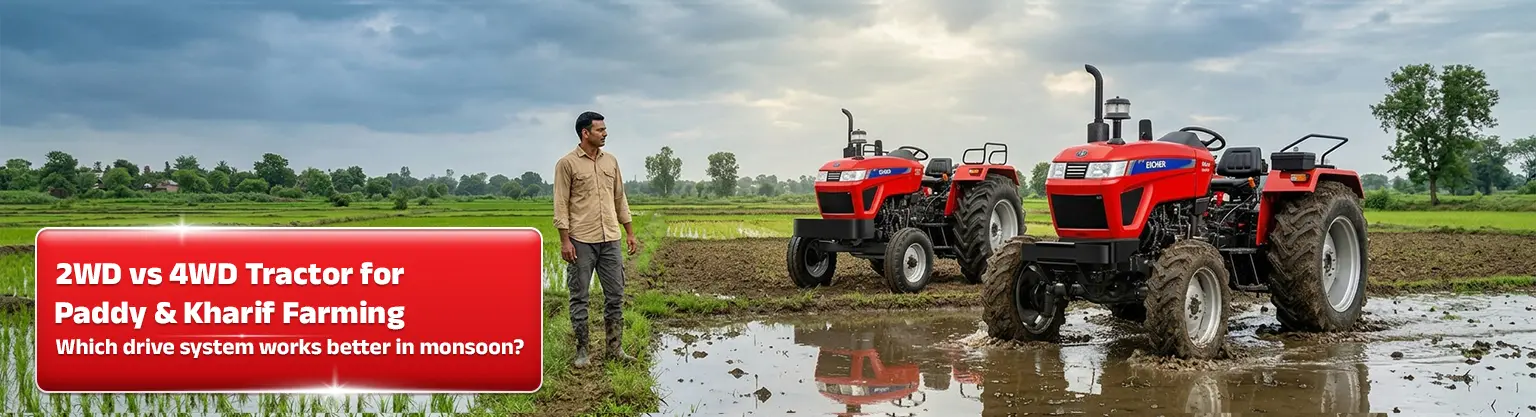
Does a 4WD Tractor Actually Make a Difference in Monsoon?
Every year before Kharif, the same question comes up in mandis, at dealer showrooms, and among farming families: does 4WD actually make a difference in monsoon conditions, or is it just an extra expense?
The honest answer is: it depends entirely on your land, your soil, and the crops you grow. 4WD is not always the right choice, and 2WD is not always the wrong one. The right drive system for your farm is determined by real-world conditions, not by specifications alone.
This blog gives you a clear, crop-wise and soil-wise answer, so you can make the right decision for Kharif 2026.
What Does the 2026 Monsoon Forecast Mean for Tractor Drive System Choice?
The India Meteorological Department (IMD) has forecast a below-normal monsoon for 2026. Rainfall is forecast at 90% of the Long Period Average, with a 60% chance of a deficient season. El Nino conditions are expected to develop during the season.
Here is what this means in practical terms for your fields:
- Uneven rainfall distribution: Even in a below-normal monsoon, rainfall does not disappear equally across India. What often happens is concentrated, heavy bursts in some regions, creating waterlogged patches and slippery soil conditions, while other periods remain dry.
- Shorter sowing windows: When rain is delayed or erratic, the window between too dry to sow and too waterlogged to operate becomes very narrow. Tractors that get stuck or lose traction cost the farmer critical sowing days.
- Variable soil conditions: Fields that were baked hard in pre-monsoon heat and then receive heavy rain become particularly difficult. The surface layer becomes slippery while the sub-soil remains compacted. This is exactly where drive system choice matters most.
In short: a below-normal monsoon does not mean dry conditions throughout. It means unpredictable, uneven conditions that put more demand on traction and control, which makes understanding 2WD vs 4WD more important than ever.
What Is the Difference Between 2WD and 4WD in a Tractor?
2WD (Two-Wheel Drive)
On a 2WD tractor, only the rear wheels receive power from the engine. The front wheels are not driven; they steer but do not pull. All traction comes from the rear axle.
2WD tractors are lighter, simpler in mechanism, and easier to maintain. They perform excellently on firm, flat ground with good drainage. In normal to good soil conditions, a 2WD tractor with good rear tyre tread delivers reliable traction across a wide range of farm tasks.
4WD (Four-Wheel Drive)
On a 4WD tractor, power is delivered to all four wheels simultaneously. When the rear wheels begin to lose grip in soft, wet or slippery soil, the front wheels contribute additional pulling force, preventing wheel spin and maintaining forward movement.
4WD adds weight (primarily from the front axle and associated components), additional maintenance requirements, and higher initial investment. But in the right conditions, these trade-offs are more than justified.
2WD vs 4WD Tractor Performance in Monsoon: Head-to-Head Comparison
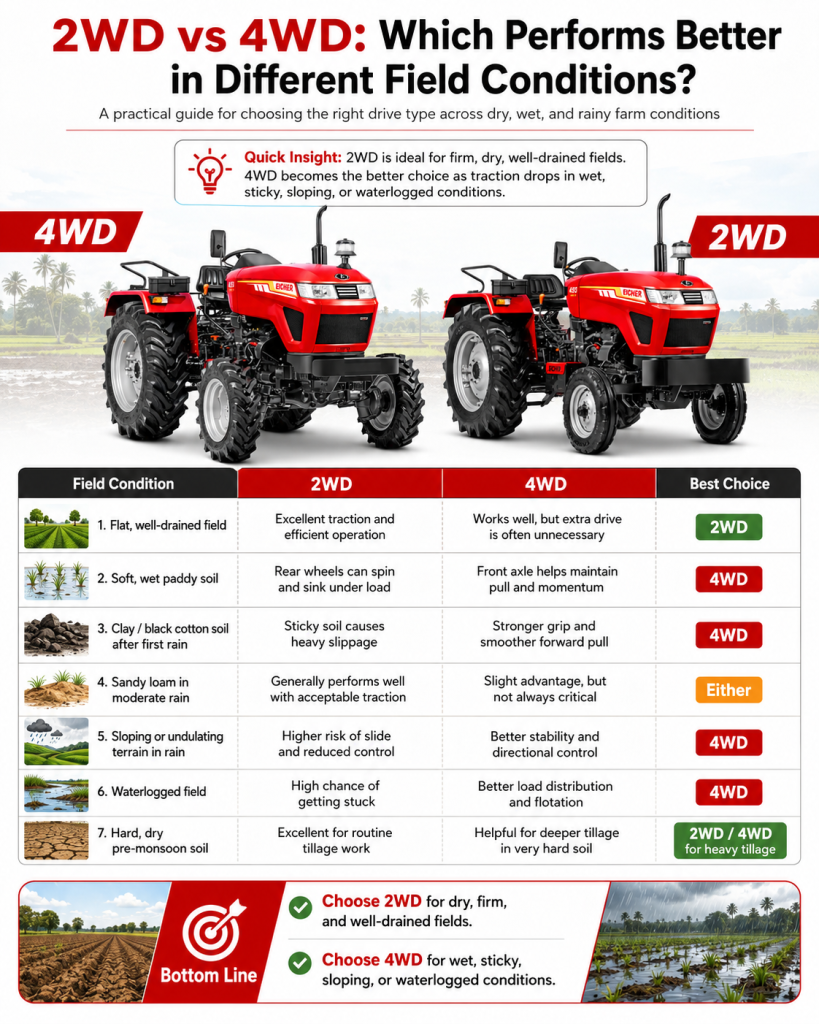
| Field Condition | 2WD Performance | 4WD Performance |
| Flat, well-drained field (normal soil) | Excellent: full traction, efficient operation | Good: slight overkill, additional weight not always needed |
| Soft, wet paddy soil (puddled) | Struggles: rear wheels dig in and spin, especially with heavy implements | Strong: front axle keeps momentum, prevents wheel sink |
| Clay or black cotton soil after first rain | Very difficult: dense, sticky soil causes rear wheel slippage | Excellent: 4WD pulls through without losing momentum |
| Sandy loam soil in moderate rain | Good: sandy soil drains faster, reasonable traction maintained | Good: 4WD advantage present but less critical |
| Sloping or undulating terrain in rain | Risky: rear-only drive creates lateral slide risk on slopes | Safer: all-wheel drive gives better directional control |
| Waterlogged field (standing water) | High risk of getting stuck due to loss of rear traction | Much better: distributes load across 4 wheels, better flotation |
| Hard, dry pre-monsoon soil (tillage) | Excellent: rear traction fully adequate for ploughing | Good: 4WD useful for deeper tillage in very hard soil |
Which Tractor Drive System Is Best for Each Kharif Crop?
Paddy (Rice): Should I Use 2WD or 4WD for Puddling?
Paddy farming is where 4WD makes its strongest case. Paddy fields require puddling, which means working the soil in standing water to create the anaerobic, waterlogged conditions that paddy roots need. This is one of the most traction-demanding tasks a tractor performs.
In puddled fields, the soil has zero firmness. Rear-only drive causes rear wheels to spin and dig down, leading to the tractor sinking and becoming stuck. 4WD distributes the drive force across all four wheels, keeping the tractor moving and the puddler working at consistent depth.
| Recommendation for Paddy: 4WD is strongly recommended for farmers doing paddy puddling and transplanting field preparation. For lighter paddy work such as spraying or harvesting on drained fields, 2WD can manage adequately. |
Sugarcane: Is 4WD Necessary for Clay Soil Farming?
Sugarcane is a demanding crop for drive system performance for two distinct reasons. First, the fields are often in heavy clay or black cotton soil that becomes particularly sticky after rain. Second, sugarcane requires inter-row cultivation and earthing-up operations with heavy implements, placing sustained lateral load on the drive system.
In wet sugarcane fields, 2WD tractors frequently experience rear wheel slippage during earthing-up passes, particularly when the soil is moist and the implement resistance is high. 4WD maintains consistent forward movement and more uniform earthing-up depth.
| Recommendation for Sugarcane: 4WD is recommended for sugarcane on clay and black cotton soils, particularly for inter-cultivation and earthing-up in wet conditions. On lighter, well-drained soils, a high-HP 2WD can perform adequately. |
Soybean in MP and Maharashtra: 2WD or 4WD for Black Cotton Soil?
Soybean is primarily grown on medium black cotton soil across Madhya Pradesh and Maharashtra. Kharif soybean is sown just as the monsoon arrives, typically late June to mid-July, when soil moisture levels are rising but fields are not yet saturated.
In these conditions, a well-maintained 2WD tractor with good rear tyres performs well for sowing and early cultivation. The key window is soil preparation before sowing: ploughing and rotavating into moist but not waterlogged black cotton soil. Here, 4WD provides a meaningful advantage in traction during tillage.
| Recommendation for Soybean: 2WD works for most soybean operations on medium soils. If your farm has heavy black cotton soil or slopes, 4WD gives meaningful traction advantage during pre-sowing tillage and early-season operations. |
Maize: Is 2WD Enough or Do I Need 4WD?
Maize is typically sown on well-drained soils such as sandy loam, red loam or light clay, and is less demanding on traction than paddy or sugarcane. In normal conditions, a 2WD tractor handles maize cultivation excellently. However, if your maize fields are on slopes, undulating terrain, or receive concentrated rainfall that creates waterlogged patches, 4WD provides significantly better control and safety.
| Recommendation for Maize: 2WD is generally adequate for maize on flat, well-drained land. Farmers in hilly or undulating regions should consider 4WD for safety on slopes. |
Which Soil Types Need 4WD? A Terrain-Wise Guide
Beyond crop type, the terrain of your land is an equally important factor in drive system choice.
- Flat, well-drained plains: 2WD performs well for most operations. The soil structure supports traction naturally, and the additional weight of 4WD may not deliver proportionate benefit.
- Heavy clay or black cotton soils: These soils become extremely sticky and adhesive after rain, like wet putty. 4WD is strongly recommended, regardless of crop type.
- Sloping and undulating land: On slopes in wet conditions, rear-only drive creates a directional instability risk. The tractor can slide laterally, particularly during headland turns. 4WD gives the front wheels active braking and steering authority, improving safety significantly.
- Paddy flood-irrigated regions: Particularly in Punjab, Haryana, West Bengal, and southern paddy belts, waterlogged conditions during transplanting demand 4WD. Farmers who switch from 2WD to 4WD for paddy operations report dramatically fewer stuck-tractor incidents.
- Light sandy soils: Sandy soils drain quickly and offer reasonable traction even when wet. 2WD often performs well here. If the sandy soil is on a slope, 4WD becomes relevant again.
Which Eicher 4WD Tractor Is Right for Your Farm?
Eicher offers 4WD options across the HP range, so you can find the right power and drive combination for your specific farm requirements:
- Eicher 380 PRIMA G3 4WD (40 HP): The balanced choice for medium farms needing 4WD for paddy puddling, soybean tillage, and varied Kharif operations. Multi-speed PTO ensures compatibility with a wide range of driven implements.
- Eicher 485 Super+ 4WD (49 HP): For farmers who need additional horsepower with 4WD, suited to heavy clay soils, sugarcane earthing-up, and demanding Kharif cultivation tasks. Heavy-duty front axle designed for sustained 4WD operation.
- Eicher 551 PRIMA G3 4WD (49 HP): With 2100 kgf hydraulic lifting capacity and advanced PTO options, this model is built for farmers running large rotavators, cultivation implements, and heavy trailer work alongside 4WD field operations.
For each of these models, your nearest Eicher dealer can help match the tractor to your specific soil type, land size, and Kharif crop mix.
The Right Drive System for Your Farm: Talk to an Eicher Expert
There is no universal answer to the 2WD vs 4WD question. The right choice depends on your soil, your crops, your terrain, and how you farm. What matters is making an informed decision before the season begins, not after your tractor gets stuck mid-field.
To speak with an Eicher product expert or arrange a demo of the 4WD range on your farm, call: 1800 2020 200
Or visit eichertractors.in to explore the full range and find your nearest dealer.
Frequently Asked Questions: 2WD vs 4WD Tractor in Monsoon
Q1. Is a 4WD tractor harder to maintain than 2WD?
Q2. Do I need 4WD even if my paddy field is flat?
Q3. Can I switch between 2WD and 4WD while farming?
Q4. Does 4WD use more fuel than 2WD?
Q5. Which Eicher 4WD tractor should I choose for a mixed paddy and soybean farm?
Disclaimer:
The information in this blog is intended for general awareness and guidance only. Tractor performance may vary depending on soil type, crop, terrain, rainfall intensity, implement usage, maintenance condition, tyre condition, and operator handling. Monsoon-related references and forecasts should be checked with the latest official weather updates before making farming decisions. Farmers are advised to consult their nearest Eicher Tractors dealer or product expert for model suitability, field demonstrations, and recommendations based on their specific farm conditions.