

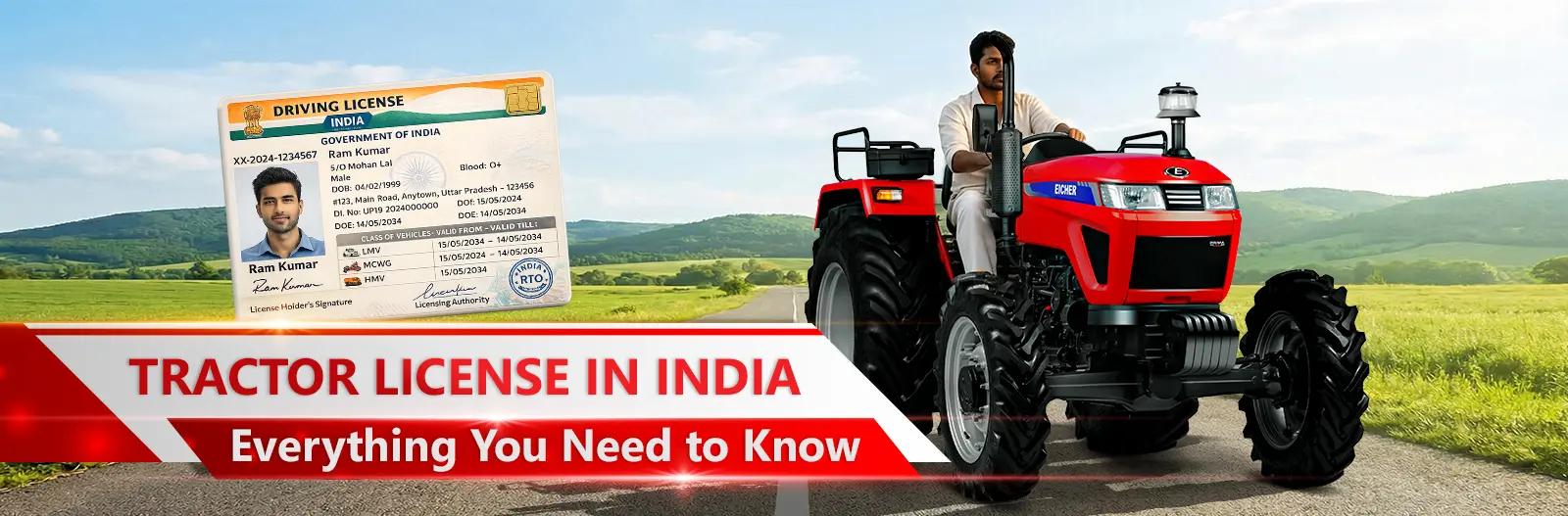
Tractors are the undisputed backbone of rural India. From early morning fieldwork to transporting crops and goods, they’re a part of everyday life. But here’s something many farmers and tractor owners still wonder about – which license is required for a tractor in India?
It’s a fair question. After all, tractors aren’t just used inside farms anymore. They often hit public roads, too. And that’s where rules start to matter.

Do You Need a Driving License to Drive a Tractor in India
The short answer? Yes, but it depends on where you’re driving.
Driving a Tractor on Public Roads
Driving a tractor on public roads comes under the Motor Vehicles Act. This means a valid license for tractor use is mandatory.
Without a valid tractor driving license in India, you could face fines or even legal trouble. It might feel like a small thing, but authorities do take it seriously, especially in areas where tractors are frequently used for transport.
Driving a Tractor Only in Agricultural Fields
A driving license is generally required when operating on public roads. For private land use, applicability may differ based on circumstances and local enforcement.
That said, it’s still a smart idea to have one. Why? Because situations change. You may need to take the tractor out for repairs, fuel, or transport, and at that point, a tractor license in India becomes essential.
Which Driving License Is Required for Tractor Driving in India
Now let’s get to the core question: which license is required for a tractor in India? Most tractors fall under the Light Motor Vehicle category. In many cases, agricultural tractors may be driven with a license category permitted by the local RTO. However, the exact license requirement depends on the tractor’s classification, registered use, weight, and whether it is used with trailers or for commercial transport. Always verify with your local RTO.
LMV (Light Motor Vehicle) License
Under the Motor Vehicles Act, a tractor with an unladen weight not exceeding 7,500 kg falls under the Light Motor Vehicle category. This covers most standard agricultural tractors, subject to registration and usage conditions
If your tractor falls within LMV classification, an LMV licence is generally sufficient. However, requirements can vary when the tractor is used with trailers/trolleys, for commercial transport, or under state-specific RTO rules.
Agricultural Tractor License (AGTLR Category)
In some states, Regional Transport Offices (RTOs) offer a specific category known as AGTLR (Agricultural Tractor and Power Tiller). Some states may maintain specific endorsements or categories for agricultural vehicles. Availability varies by state and RTO.
This is a more specialised tractor driving license meant specifically for farm machinery. While it’s not mandatory everywhere, it can be useful if you’re primarily working in agriculture.
When an HMV License Is Required
An HMV (Heavy Motor Vehicle) license is usually required for large commercial vehicles like trucks and buses. Standard agricultural tractors don’t fall into this category.
However, if your tractor is being used for commercial transport or attached to heavy trailers for business purposes, rules may vary slightly. In most regular farming scenarios, though, you won’t need an HMV license.
Eligibility Criteria to Get a Tractor Driving License
Getting a tractor driving license in India isn’t complicated. The process is quite similar to applying for any other driving license.
Minimum Age Requirement
You need to be at least 18 years old to apply for an LMV license. That’s the minimum age for legally driving a tractor on public roads.
Learner’s License
Before getting a permanent license, you’ll need a learner’s license. This allows you to practise driving legally while preparing for the test. It’s the first step toward getting your tractor license in India. A learner’s license is typically valid for 6 months. You can apply for a permanent license at your RTO after holding it for at least 30 days.
Driving Test at RTO
Once you’re ready, you’ll have to take a driving test at your local RTO.
This test checks your ability to handle the vehicle safely. If you pass, you’ll be issued your driving license, granting you a valid tractor driving license in India.
Documents Required for Tractor Driving License
To apply for a license for a tractor, you’ll need to submit a few basic documents.
Identity and Address Proof
Documents like the Aadhaar card, voter ID, or passport are commonly accepted. These confirm your identity and residence.
Age Proof
You’ll need to provide proof of age, such as a birth certificate or school certificate, to confirm you meet the eligibility criteria.
Learner’s License and Application Form
Your learner’s license and completed application form are also required when applying for a permanent tractor driving license.
Penalties for Driving a Tractor Without a License
Traffic Fines
Driving a tractor on public roads without a valid license required for tractors in India attracts fines of Rs. 5,000 under the Motor Vehicles Act, depending on state rules.
Legal Consequences
In serious cases, repeated violations can lead to stricter penalties, including legal action or even vehicle seizure.
It’s simply not worth the risk, especially when getting a license is a straightforward process.
If you’re buying a new tractor and need guidance on documentation, registration, and road compliance, your nearest EICHER Tractors dealer can help walk you through the process alongside your purchase.
Conclusion
So, coming back to the main question: which license is required for a tractor in India?
In most cases, an LMV license for tractor use does the job. It covers standard agricultural tractors and keeps you legally safe when driving on public roads. Even if you mostly use your tractor within your farm, having a valid tractor driving license in India is always a smart move. It gives you flexibility and peace of mind.
Disclaimer: License requirements for tractors in India may vary depending on vehicle classification, intended use, state regulations, and latest legal provisions. Please confirm with your nearest Regional Transport Office (RTO) before operating any tractor on public roads.