

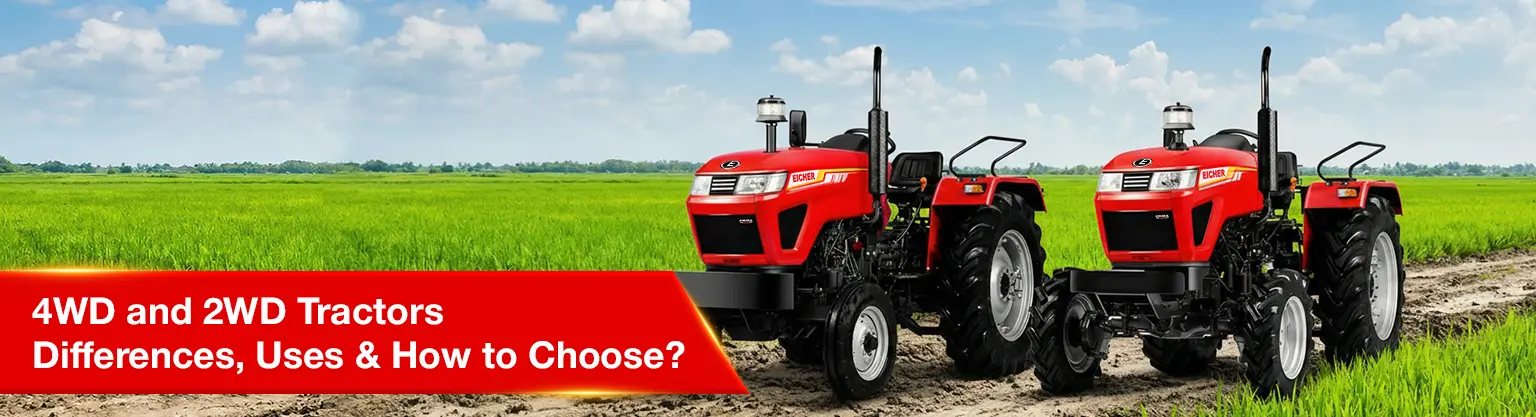
Introduction: Choosing the Right Tractor for Your Farm
Your terrain, crop cycle, and implements decide everything. Flat wheat-paddy belts can run efficiently on a 2WD tractor, while hilly or wet fields (terraced paddy, vegetables, pulses) demand the traction and stability of a 4×4 (4WD). The 2WD vs 4WD tractor difference impacts fuel efficiency, pull, safety on slopes, and total cost. This tractor buying guide (India-focused) compares features and use cases to help you find the right tractor for your needs.
Looking for the best tractor in India? Explore our 2WD and 4WD picks below and find your perfect match.
What is 2WD?
In a 2WD tractor, the rear wheels drive the machine. This setup suits small to medium farms on flat terrain and is a common pick in India.
Pros of 2WD tractors:
- Lower purchase price & simpler maintenance; great mileage on flat lands
- Lighter weight for easy manoeuvrability in narrow plots
- Works well for sowing, light tillage, inter-cultivation, and transport
What is 4WD?
4WD means all four wheels drive the tractor, delivering superior traction, control, and tractor stability on slopes and uneven terrain. It’s ideal for hilly areas, wet fields, and heavy implements, though 4WD tractor prices and maintenance are higher than 2WD.
Pros of 4WD tractors in India:
- Better tractor stability on slopes and uneven terrain
- Increased pulling power for heavier implements (4–5 ft rotavator, seed drill)
- Ideal for hilly areas, wet paddy fields, and all-weather operations
2WD vs 4WD Tractor Difference: Key Factors
| Feature | 2WD Tractor | 4WD Tractor |
| Traction & Terrain | Best on flat, dry fields; light tillage & transport | Superior grip on mud, slopes, and terraces; safer descents |
| Power Delivery | Rear-wheel only; wheels can slip under load | All-wheel drive reduces slip; stronger draft for implements |
| Fuel Efficiency | Very good in light to medium work | Slightly higher fuel use, but reduced wheel slip and fewer corrective passes improve overall efficiency on tough fields |
| Implements | Cultivator, light rotavator, seed drill, trolley | 4–5 ft rotavator, heavier seed drills, plough, trailer loads |
| Maintenance | Simple, lower cost | Higher complexity; requires timely axle/hub service |
| Price | Lower upfront and running costs, ideal for flat-terrain farms | Higher, but boosts uptime and safety in hard terrain |
| Operator Safety | Adequate on plain fields | Better control with oil-immersed brakes & 4WD stability |
Best Eicher Tractor Models & Their Applications: Which Tractor to Choose for What
Check this quick guide to compare applications and pricing, so you can decide between a 2WD tractor and a 4×4 (4WD) tractor for your fields.
| Tractor Type | Best For (Applications) | Typical Terrain | Top Models |
| 2WD tractor | Small–medium farms, light-duty ploughing, sowing, inter-cultivation, hauling small loads | Flat lands, firm soils | Eicher 650 2WD PRIMA G3, Eicher 551 SUPER PLUS 2WD PRIMA G3, Eicher 551 2WD PRIMA G3, Eicher 333 SUPER PLUS 2WD PRIMA G3, Eicher 557 2WD PRIMA G3, Eicher 380 2WD PRIMA G3 |
| 4WD tractor (tractor 4×4) | Large farms, heavy-duty work, towing trailers, all-weather operations | Hilly terrain, wet/muddy fields, uneven slopes | Eicher 650 4WD PRIMA G3, Eicher 485 Super PLUS 4WD, Eicher 551 4WD PRIMA G3, Eicher 480 4WD PRIMA G3, Eicher 557 4WD PRIMA G3, Eicher 380 4WD PRIMA G3, Eicher 557 4WD, Eicher 551 4WD, Eicher 480 4WD, Eicher 380 4WD |
Suggested Video: EICHER Tractors | A partner for generations to come
When to Consider 2WD Tractors and 4WD Tractors
When to Consider 4WD Tractors
- Better Traction – A 4WD tractor (tractor 4×4) powers all wheels, gripping muddy paddy, wet fields, and gradients, ideal for the best tractor for hills and rain-affected belts.
- Improved Stability – Fully sealed front axles and oil-immersed brakes enhance tractor stability on slopes, reducing slide/tip risk on terraces and uneven tracks.
- Higher Performance – Confidently runs bigger implements (4–5 ft rotavator, heavy seed drills, ploughs) and handles trailer loads with fewer corrective passes, saving fuel and time.
- Long-Term Investment – Versatile across paddy, wheat, maize, pulses, and vegetables, and higher uptime offsets a higher 4WD tractor price in India with better productivity.
When to Consider 2WD Tractors
- Excellent Efficiency on Flat Land – On firm, level soils, a 2WD tractor handles sowing, inter-cultivation, spraying, and short-haul transport with outstanding fuel efficiency and smooth manoeuvrability.
- Lower Ownership Cost – A 2WD tractor comes with a lower purchase price and simpler mechanics, keeping maintenance straightforward and running costs predictable, a smart fit for farms where 4WD capability simply isn’t needed.
- Perfect for Everyday Farm Tasks – For seed drilling, light tillage, and regular trolley runs on plains, 2WD delivers reliable, consistent performance day after day.
Conclusion
2WD delivers excellent efficiency, manoeuvrability, and reliability on flat land. 4WD brings superior traction, stability, and power for hills and heavy-duty work. Eicher Tractors strengthens both sides with proven specs: Hydromatic hydraulics, Eco/Multi-Speed PTO, side-shift (8+2/9+3) gearboxes, and multi-disc oil-immersed brakes plus 4WD front axles on hill-ready models.
Ready to choose the best tractor for your farm? Explore our range of 2WD and 4WD tractors and find the model that fits your terrain, crops, and budget.