

Quick Overview
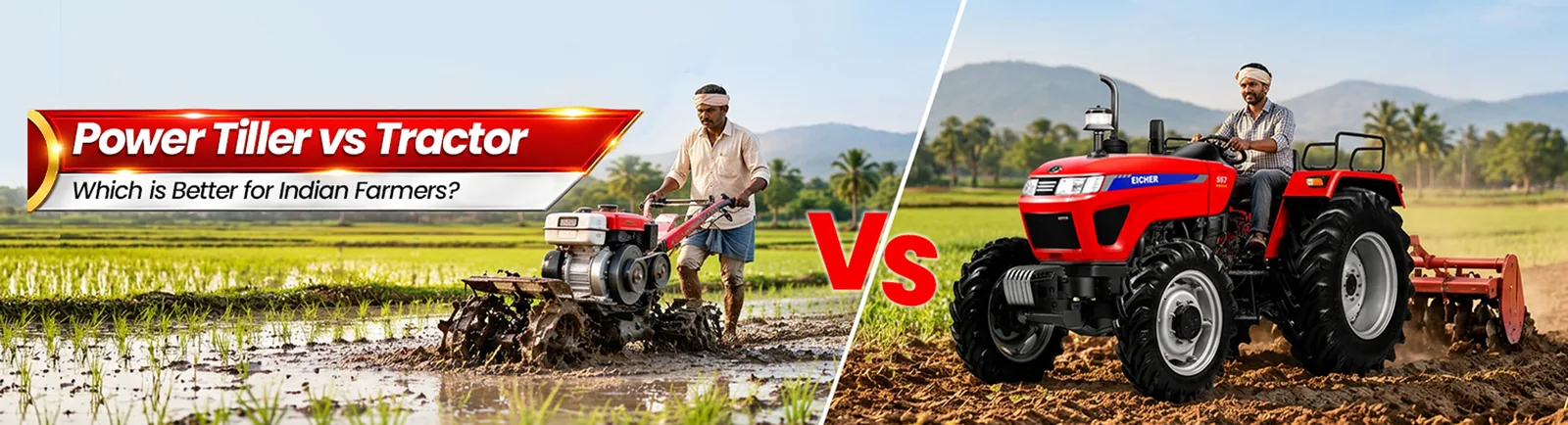
For smaller plots, narrow fields, wetland farming or jobs that mainly involve tillage and interculture, a power tiller can be a practical and economical option. A tractor generally offers greater power, higher work capacity and compatibility with a wider range of implements. The right choice depends on land size, field conditions, crops, implements and how many different jobs the machine needs to perform. Neither wins every time. This power tiller vs tractor decision comes down to land size, crop type, and how many jobs you need.
Key takeaways:
- Power tillers are commonly available in lower power ranges and are well suited to operations such as tillage, puddling, sowing and interculture on smaller or restricted-access fields.
- Tractors are available across a wide range of power levels, from compact models below 20 HP to machines above 50 HP, offering greater capacity for heavier implements and multiple applications. That adds ploughing, haulage, and implement versatility.
- A power tiller generally uses less fuel per hour than a tractor because of its lower power and smaller size. Its capacity for heavy implements and haulage is more limited, although suitable power tillers can be coupled with trolleys for transportation.
- As farm area, workload, implement requirements or transport needs increase, a tractor may offer greater productivity and versatility. The decision should be based on total workload rather than acreage alone.
Buying the wrong machine can eat a season’s profit. That happens before you’ve even sown the first crop. Every year, farmers plan to buy one machine. They end up comparing two instead. That’s not confusing. It’s a real trade-off.
The power tiller vs tractor question isn’t about which machine is ‘better’ overall. It’s about which one matches your land, your crop calendar, and your running costs. A 1-acre vegetable plot and a 5-acre multi-crop farm need different answers.
This piece covers what separates the two machines. It shows where each one wins, and the mistakes that cost farmers money before they’ve even started ploughing.
Quick Comparison Table
Here’s a quick power tiller vs tractor comparison on the factors that matter most. For general HP-to-acreage guidance, extension services publish local recommendations.
| Factor | Power Tiller | Tractor |
|---|---|---|
| Typical power | Generally lower HP; many common models fall around 8–16 HP | Wide range, including compact models below 20 HP. |
| Best suited land size | Smaller plots, narrow fields, terraces and wetland applications | Small to large farms depending on workload, implements and field conditions |
| Core strength | Tilling, puddling, weeding | Ploughing, haulage, multiple implements |
| Running cost per hour | Lower | Higher, but covers more ground per pass |
| Manoeuvrability | Very high, works in tight or wet plots | Needs more turning space |
| Versatility across seasons | Tillage, puddling, sowing, weeding, spraying and other compatible operations. | Broad, pulls trolley, sprayers, and more |
| Upfront investment | Lower | Higher |
Difference Between Power Tiller and Tractor
The difference between a power tiller and tractor starts with how the engine drives the machine.
A power tiller is generally a single-axle machine operated by a person walking behind it, although some models can use riding attachments. Its engine powers the drive system and compatible implements for operations such as tillage, puddling and interculture.
A tractor is different. It’s a four-wheeled prime mover that pulls or powers separate implements through a PTO shaft and hydraulic lift.
That difference shapes everything else. A power tiller is primarily designed for lighter farm operations, but compatible attachments can extend its use to several agricultural tasks.
A tractor is a platform: one machine, many attachments, from cultivators to trolleys to sprayers. You’re not just buying horsepower. You’re buying how many tasks that horsepower can be redirected to.
Suggested Read: Soil Types in India: How to Choose the Right Tractor for Better Farming Results
Tractor for Small Farms: When It Makes Sense
A tractor can make sense even on a relatively small farm when it is used across several operations, such as land preparation, sowing, implement operation and haulage. Its value depends on annual usage, cropping intensity, implement requirements and transport needs rather than farm size alone.
Smaller compact tractor models exist for exactly this bracket. They aren’t the same as the 50+ HP machines built for large operations. They’re sized and priced for this decision.
If your farm has multiple crops, heavier field operations or regular transport requirements, a tractor may offer greater overall versatility and productivity.
Suggested Read: How to Choose the Best Tractor for Farming Needs: Power, Implements & Productivity Guide
Power Tiller for Small Farmers: Where It Wins
A power tiller can be particularly useful for smaller holdings, narrow plots, wet fields and locations where operating a larger tractor is difficult. It’s especially strong on wet-field crops like paddy. Its light footprint means less soil compaction. Its tight turning radius handles small, irregular fields where a tractor struggles.
Running costs are the other draw. Lower fuel use per hour adds up fast on a small plot worked several times a season. For operations such as puddling, weeding and tillage, a power tiller can provide an efficient solution without requiring a larger machine.
Agricultural Machinery for Small Farms: Cost Reality
The purchase price is only the opening figure. Any agricultural machinery decision for small farms must also account for fuel, servicing, and spare parts. Ask how many seasons the machine will actually earn to prove its value.
A cheap machine that sits idle half the year isn’t really cheap. Government mechanisation schemes can offset some of this cost. A tractor’s ploughs, trolleys, and cultivators cost extra. But they stretch what one machine can do across the whole farming calendar.
A Simple Choice Framework
Cut through the power tiller vs tractor decision with four questions.
- How much land are you working? Smaller, narrow or restricted-access fields may favour a power tiller. As workload, field area and implement requirements increase, a tractor’s higher capacity may become more valuable.
- What’s your cropping pattern? Single-crop wet fields suit a tiller. Multi-crop or rotation farming suits a tractor’s range of implements.
- Do you need regular or heavier haulage? A tractor generally offers substantially greater transport capability, although suitable power tillers can also tow trolleys for lighter transportation work.
- What’s your running-cost tolerance? For lighter workloads, a power tiller’s lower fuel consumption and operating cost can be an advantage. Compare this with the tractor’s higher field capacity and wider range of applications.
Answer these honestly before you compare brochures.
Mistakes Farmers Make Before Buying
Get the power tiller vs tractor decision wrong here, and it costs you for years.
- Buying tractor horsepower the land will never use, paying for capacity that sits idle.
- Ignoring implement compatibility, then discovering the plough or trolley needs a separate purchase.
- Skipping a test run on your own field, not just the dealer’s demo plot.
- Underestimating service distance. A far-off centre turns a small repair into a lost week.
Real-World Farm Scenarios
Numbers aside, these power tiller vs tractor scenarios show the decision in practice.
- A farmer working a relatively small, wet paddy field may find a power tiller suitable because of its compact size, manoeuvrability and suitability for puddling operations.
- A farmer managing multiple crops and regularly hauling produce to the mandi may benefit more from a tractor because the same machine can support several field operations as well as transport.
- As a farm expands or adds more crops, implements and transport requirements, the farmer may consider moving from a power tiller to a tractor for higher capacity and broader application versatility.
Before You Finalise the Purchase
Before signing anything, check the essentials.
- Ensure implement compatibility with the exact model, not just the brand
- Local service centre distance and average turnaround time
- Fuel and maintenance costs for a full season, not just month one
- Financing terms and any government subsidy scheme for your state
- Resale demand for that model in your district
Conclusion
There is no universal winner in the power tiller vs tractor debate. For smaller, narrow or wet fields and lighter operations, a power tiller can be practical and economical. Where farming requires greater field capacity, heavier implements, regular haulage or multiple applications, a tractor can offer significantly greater versatility.
Before you buy, walk your own field with the machine. Don’t just tour the showroom floor. Match the machine to the acres and crops you actually have, not the ones you’re planning for someday.
FAQs
1. Which tractor is best for small farmers?
2. Can a power tiller be used on hills?
3. What are the common problems with power tillers?
4. Which power tiller is best in India?
Disclaimer: This article provides general information comparing power tillers and tractors, which should not be taken as professional agricultural or financial advice. Specifications, pricing, and government subsidy availability vary by region and over time, so farmers should consult local dealers and agricultural extension services for advice tailored to their specific fields.