

Quick Overview
Coconut farming requires consistent long-term management, and the right tractor and implements can make several plantation operations faster and less labour-intensive. Planting material, spacing, soil fertility, moisture management, weed control and pest and disease management all influence plantation performance over time.
Key takeaways:
- Coconut palms need roughly 7.5 to 8 metres of spacing between trees in standard plantations.
- Basin weeding and inter-row cultivation benefit most from tractor-mounted implements.
- Kerala, Tamil Nadu, Karnataka and Andhra Pradesh are among India's leading coconut-growing states.
- Central and state mechanisation schemes can offset some equipment costs for eligible farmers.

A coconut palm takes years to bear its first real harvest. Mistakes made at planting stay with the plantation for decades. Most guides focus on the palm itself. Few explain where a tractor actually helps.
Coconut farming spans land preparation, irrigation, feeding, and years of routine maintenance before the trees pay back the investment. Some of that work suits manual labour. Some of it doesn’t.
This blog covers the plantation basics, where tractors genuinely help, and the mistakes that quietly cut into yield.
Coconut Plantation Basics in India
Coconut farming rewards long-term planning more than quick fixes. The time to first bearing depends on the variety. Dwarf and some hybrid types may begin flowering or bearing in around 3-4 years, while tall varieties commonly take around 5-7 years.Coconut can be grown in suitable coastal and inland areas where soil depth, moisture availability, climate and drainage are favourable. Irrigation may be required where rainfall does not provide adequate moisture.
Standard spacing runs around 7.5 to 8 metres between palms. That gives each tree room for a full canopy at maturity.
Coconut Cultivation in India: Field Setup
Coconut cultivation in India starts with pit preparation, not planting. Pit dimensions and preparation depend on soil and site conditions. A commonly recommended practice is to prepare suitable planting pits and fill them partly with topsoil mixed with farmyard manure before planting the seedling.
Land levelling and drainage channels matter as much as the pits themselves. Good drainage is essential, particularly for young palms, because prolonged water stagnation can adversely affect establishment and growth.
Where Tractors Fit in Coconut Farming Methods
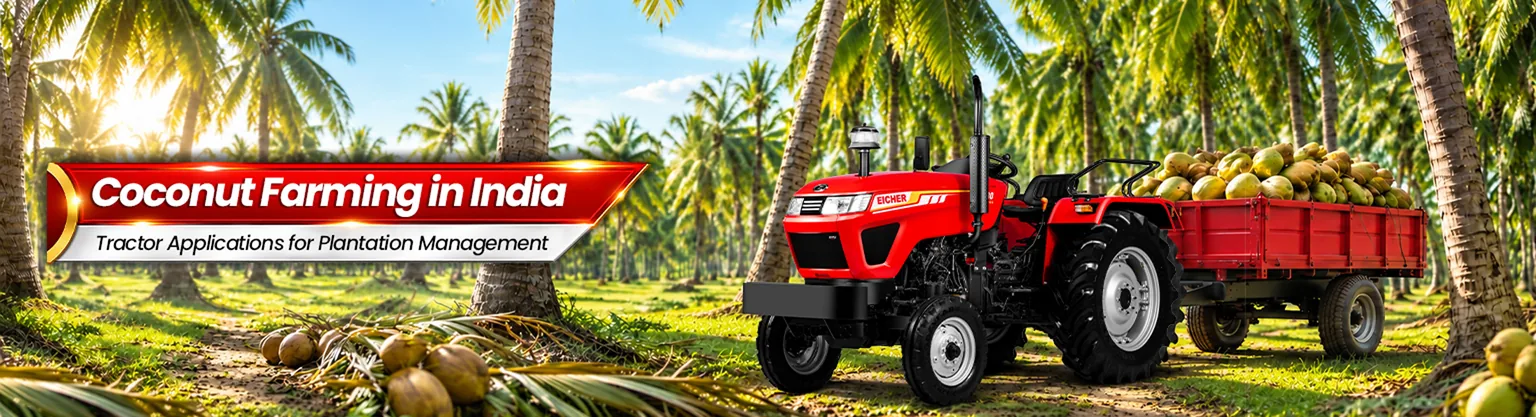
Coconut farming methods split cleanly into tasks a tractor helps with and tasks it doesn’t. With the right attachment, pit digging, inter-row cultivation, and basin preparation are all faster. Harvesting itself still relies on manual climbing or specialised aids, not tractors.
Tractor-drawn trolleys can support the movement of harvested nuts, husks, manure and other materials within and around the plantation. Suitable implements can help incorporate green-manure crops in plantation interspaces. Operations should be carried out at an appropriate depth and distance from the palm to minimise disturbance to the root zone.
Spraying equipment may support certain pest and disease-management applications where the target area is accessible. Pest management in mature coconut palms should follow recommendations for the specific pest and local conditions.
Recommended Tractor Power Range
Compact tractors in the 24-35 HP range can suit many light-to-medium plantation operations where manoeuvrability is important. The required tractor power should ultimately be matched to the implement, PTO requirement, lifting capacity, terrain, row spacing and haulage load. This power range provides useful manoeuvrability within plantation inter-rows, subject to actual row layout, intercrops, terrain and canopy clearance.
Suggested Read: 5 Reasons Why Farmers Trust Iconic Eicher 242 Tractor!
Essential Implements for Coconut Farming
- Post Hole Digger: Can assist with initial pit preparation in suitable soils. Final pit dimensions and preparation should follow local horticultural recommendations for the soil and site.
- Rotavator / Rotary Tiller: Supports controlled inter-row weed management and incorporation of organic material. Working depth and distance from the palm should be managed carefully to minimise root disturbance.
- Trolley: Transports harvested coconuts, organic manure, fertilisers and other plantation materials.
- High-Pressure Orchard Sprayer: Can support suitable spray applications where canopy height, sprayer reach and the recommended treatment allow mechanised spraying. Always follow crop-protection recommendations for the specific pest or disease.
Suggested Read: Top Tractor Implements & Attachments You Must Have For Farming
Coconut Farm Machinery for Daily Operations
Coconut farm machinery for routine plantation work usually includes:
- Post-hole diggers or augers for pit preparation at planting
- Rotary tillers for inter-row weed control and aeration
- Trolley for moving husk, fronds, and harvested nuts
- Sprayers for pest and disease control on younger palms
Coconut Plantation Management by Crop Stage
Coconut plantation management shifts with palm age.
- Years 1 to 3: irrigation and moisture management, basin development, weed control, nutrient application and regular pest and disease monitoring
- Years 4 to 6: continued irrigation, nutrition, weed and interspace management, along with harvesting preparation as palms approach bearing
- Bearing stage: harvesting, nutrition, irrigation, pest and disease management, inter-row operations and material transport. Bearing age varies by variety and management conditions.
Irrigation, Nutrition and Weed Control
Coconut palms need consistent watering, especially in the first three years. Where irrigation is required, drip irrigation can improve water-use efficiency by supplying water close to the active root zone. The appropriate irrigation method and schedule depend on soil, climate, rainfall and palm age.
Keeping the palm basin and plantation interspaces appropriately managed helps reduce competition for water and nutrients, particularly during establishment. Left unchecked, weeds compete directly with young palms for water and nutrients.
Profitability and 1-Acre Planning
At square spacing of around 7.5 × 7.5 m to 8 × 8 m, an acre accommodates roughly 63-72 palms. Actual plant population varies with spacing and planting system. Income depends heavily on palm age, variety, and market access for copra or fresh nuts. Treat any fixed profit figure with caution.
Coconut farming profitability depends far more on management consistency than on any single input. Mechanisation can reduce labour requirements for suitable operations such as inter-row cultivation, material handling and spraying, depending on plantation layout and equipment utilisation.
Common Mistakes in Coconut Plantation Management
These mistakes are why coconut farming outcomes vary so much between neighbouring plots.
- Planting too densely, which crowds canopies and cuts yield per palm over time
- Skipping drainage planning, leading to waterlogged pits and palm loss
- Allowing inadequate moisture during the establishment years, when young palms require careful water management
- Delaying fertiliser scheduling until deficiency symptoms already show
Schemes and Subsidy Pointers for Farmers
Government support may be available through Coconut Development Board programmes, agricultural mechanisation schemes such as SMAM, and applicable state schemes. Eligibility, assistance rates and application windows vary, so farmers should verify current official guidelines before budgeting for a purchase.
Conclusion
There’s no shortcut in coconut farming, only better planning at each stage. Spacing, drainage, and consistent irrigation decide most of the outcome long before a tractor ever enters the picture.
Start with the plantation stage you’re at today. Build your equipment list around that, not around what a mature plantation eventually needs.
Disclaimer: The information in this article is provided for general informational purposes only. Farming practices, machinery suitability, tractor horsepower requirements, subsidy availability, eligibility criteria, assistance rates, and government scheme guidelines may vary depending on location, crop conditions, farm size, equipment type, beneficiary category, and prevailing government policies. Farmers are advised to consult local agricultural or horticultural authorities and refer to the latest official government guidelines before making any purchase, subsidy application, or farm management decision. Tractor and implement selection should also be based on actual field conditions and operational requirements.