

Quick Overview
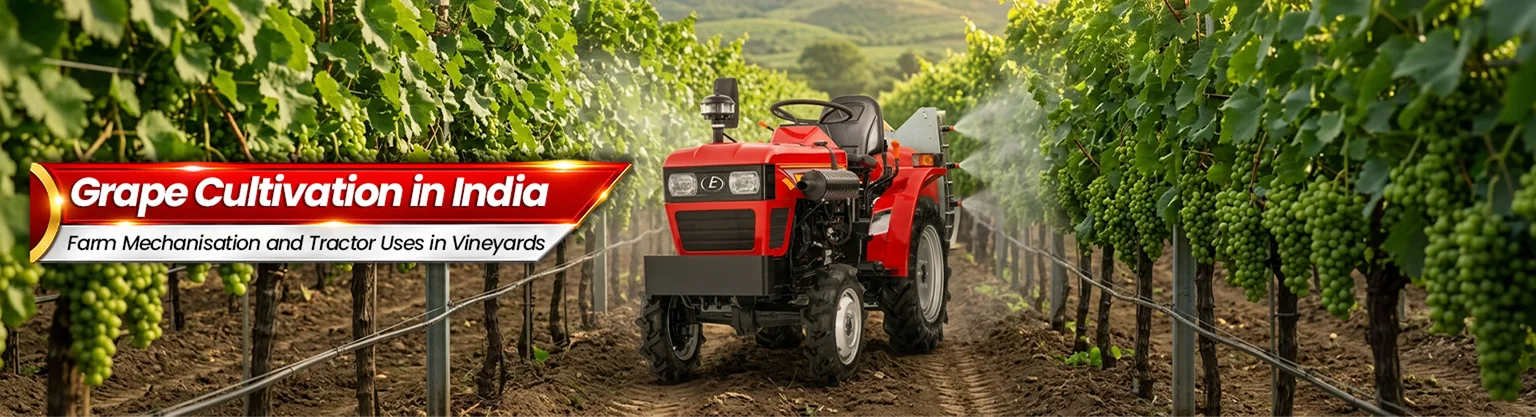
Grape cultivation in India is concentrated in a handful of states. Vineyard success depends more on trellising, spacing, and irrigation than on any single machine. Tractors can reduce time and labour requirements across operations such as land preparation, spraying, inter-row management and transport.
Key takeaways:
- Maharashtra is India’s largest grape-producing state, followed by Karnataka.
- Vineyards typically use narrower row spacing than field crops, which shapes tractor and implement choice.
- A suitable vine-training or trellis system and reliable irrigation are central to commercial grape cultivation. Drip irrigation is widely used for efficient water management where appropriate.
- Mechanisation can reduce labour and time requirements for operations such as spraying, inter-row management, manure application and transport.

A vineyard planted with the wrong row spacing stays wrong for its entire productive life. Few crops punish early mistakes as harshly as grapes do.
Grape cultivation in India has grown into a genuine commercial industry, concentrated in a few key states. Good vineyard layout, crop management and appropriate machinery all contribute to efficient vineyard operations. This guide covers where grapes are grown, what vineyards need to thrive, and where a tractor actually earns its keep. It also covers the mistakes that show up years later, once vines are already established.
Grape Farming in India
Grape farming in India centres heavily on Maharashtra, which produces the large majority of the country’s crop. Karnataka is the second-largest producer, while Andhra Pradesh, Tamil Nadu and Mizoram are also among the major grape-growing states.
Grapes generally perform well where soils are well drained and conditions are relatively warm and dry during key growth and fruit-development stages. Excess rainfall and high humidity during sensitive stages can increase disease pressure. Specific climatic, soil and management requirements vary with the variety, rootstock and whether grapes are being produced for table, raisin or wine use.
Grape Cultivation Requirements and Techniques
Grape farming techniques centre on three things: soil, spacing, and support structure.
- Well-drained soil with suitable depth and water-holding capacity
- Grapes can be grown in sandy loams, sandy clay loams, red soils, black soils and red loams depending on the region.
- Row spacing suited to the variety, training system and required machinery access
- A trellising system to train vines upward and expose fruit to sunlight
- Reliable irrigation with careful scheduling; drip irrigation is commonly used where efficient water application is required.
Errors in spacing, trellis layout or drainage can be difficult and costly to correct once the vineyard is established.
Grape Farming Equipment and Vineyard Machinery
Grape farming equipment and vineyard machinery cover the full season, from planting through harvest.
- Tractor-mounted sprayers for pest and disease control across the canopy
- inter-row tillers or cultivators sized to the available row width and operated carefully around the vine root zone
- Trolleys for transporting harvested grapes, inputs, pruning material and other vineyard loads
- Pruning tools for canopy and cane management, mostly still hand-operated
Vineyard farm equipment needs to be sized to row width first, then matched to the tasks above.
Suggested Read: Top Tractor Implements & Attachments You Must Have For Farming
Vineyard Mechanisation and Its Benefits
Vineyard mechanisation cuts the labour hours that spraying, tilling, and transport would otherwise demand by hand.
Consistency is the other benefit. Machine-applied spray coverage is more even than hand spraying, which matters for disease control across a full vineyard.
Mechanisation can reduce dependence on manual labour for operations that can be mechanised, particularly during periods of high farm activity. That reliability matters as much as the raw time saved.
Tractor Uses in Grape Farming and Vineyards
Tractor uses in grape farming and vineyards concentrate on a handful of repeat tasks. Controlled inter-row cultivation can help manage weeds and soil conditions, but working depth and distance from the vine should be managed to minimise root disturbance. Spraying equipment can support timely crop-protection applications according to vineyard monitoring and recommended crop-protection practices. Trolleys move produce, prunings, and supplies around the vineyard.
Harvesting table grapes is still largely manual, since the fruit needs careful handling. Specialised mechanical grape harvesting is used in some wine-grape production systems, while Indian table-grape harvesting remains predominantly dependent on careful manual handling.
Tractors can also support inter-row vegetation management and mechanised application of farmyard manure or compost where vineyard layout and equipment permit. Because vineyard lanes are narrow, choosing the right machinery size is crucial to avoid vine damage.
Eicher’s compact tractor range includes models that can be considered for vineyard operations where tractor dimensions, row clearance and implement compatibility suit the vineyard layout.
- Eicher 188 4WD: This 18 HP mini tractor is ideal for ultra-narrow vineyard lanes. It easily powers inter-culture cultivators and compact boom sprayers while turning effortlessly in small spaces.
- Eicher 280 Plus 4WD: Delivering 26 HP, this model combines four-wheel-drive traction with a slim profile. It is well suited for hauling fully loaded fruit trolleys and pulling heavier tilling equipment through tough clay soils.
The right compact tractor and compatible implements can help mechanise selected vineyard operations and improve day-to-day operational efficiency.
How to Choose the Right Tractor for Vineyard Farming
Row spacing determines tractor width first. A standard tractor may simply not fit between vineyard rows without damaging vines on either side.
Look for compact dimensions, suitable track width and sufficient manoeuvrability for the available rows and headlands. Confirm implement compatibility for sprayers and inter-row tillers before buying.
Test the tractor in your own rows before committing, not just on the dealer’s open ground. Just because the tractor dimensions look correct on paper does not mean it will turn easily and comfortably between your narrow rows.
Conclusion
There’s no universal setup in grape cultivation. It’s about what fits your soil, spacing, and climate. Match your equipment to the vineyard you actually have, not a generic field crop setup.
Start with row spacing and trellising design before choosing a tractor. The right machine follows the vineyard layout, not the other way round.
Disclaimer: This article provides general information on grape cultivation, vineyard mechanisation and tractor applications. Vineyard practices, spacing, irrigation requirements, machinery suitability and implement compatibility vary depending on grape variety, training system, soil, climate and local conditions. Farmers should consult local horticultural experts for crop-specific recommendations and an authorised Eicher Tractors dealer to confirm tractor and implement compatibility for their vineyard.